An overheating hippo was so desperate to cool down that he climbed over the side of a 3m (10ft) water tower for a nice long soak.
However, after happily splashing around for a while, the mammal found it could not get out of the pool and was well and truly stuck.
Luckily, a farm worker noticed water spilling over the side of the concrete container and spotted two enormous nostrils poking out of the tank.
He immediately rang for help and, within hours, rescuers arrived at the farm in Alkmaar, just outside Nelspruit in South Africa.
Chris Hobkirk’s team try to corner the beast
Equipped with a hydraulic crane and a cage, hippo hunter Chris Hobkirk and his team from the Mpumalanga Tourism and Parks Association set to work. In a four-hour operation, they drained the tank and used poles to gently nudge the hippo into the 3m-long (10ft) steel cage before winching it to safety.
Mr Hobkirk – who has rescued more than 180 stranded hippos in the past six years – said it was a tricky procedure but he was glad with the outcome.
Rescued: The red-hot hippo
‘Maybe we got lucky with this one. In the past, I have removed hippos from small dams. In those cases, the water levels have always been much lower so this was different.’
Although this hippo went to extreme lengths to cool down it is by nature a semi-aquatic animal. They usually stay in water all day until stepping on to land at dusk to graze.
Caught during a steamy moment in a lava tunnel in 2006, these two apparently mating bats – members of a new species – are each no bigger than a human thumb!
Weighing just 0.2 ounce (5 grams), Aellen’s long-fingered bat was discovered on a volcanic island in Africa’s Comoros chain. DNA analysis later confirmed the bat as a unique species.
Subsequent genetic tests also revealed the bat is also found on the west coast of the island of Madagascar.
Good old YouTube, this is a rather weird video of a remote controlled sewer-cam, used to search for blockages and to inspect the overall condition of sewer.
Unfortunately there is no reference to size or scale, but I’m guessing the pipes aren’t that big – possible too small to walk or even crawl through?
So what is it? Most YouTube comments are suggesting it’s a form of bryozoan, a tiny colonial animal that generally builds a stony skeletons of calcium carbonate similar to coral.
But whatever these things are they don’t appear to have a hard structure! That’s when I discovered that some species of bryozoan can lack any calcification and instead have a mucilaginous or viscous like structure (source: Wikipedia).
Others have suggested it could be aestivating land snails waking up (seems unlikely as it’s generally wet in the servers) or even a type of fresh water jellyfish?
A History Channel/Monster Quest mashup that appears to debunk the whole Skyfish or Flying Rods phenomena.
Filing at night opens up all sorts of questions and I’m wondering if they should have also shot some high-speed footage in daylight to use as a comparison?
I’m not a huge fan of Monster Quest, it’s entertaining, but I find it tends to jump to conclusions to quickly for my liking – but it is entertaining – so I guess we will have to live with it?
A mysterious cylindrical object has been spotted in the skies above the Black Country.
Retired teacher Mike Tunnicliffe was left scratching his head after seeing the UFO from his Walsall garden yesterday afternoon (28th June 2009).
Mr Tunnicliffe, who works part time at County Bridge Primary School, ran to get his camera and snapped the strange shaped object.
The 63-year-old of Sutton Road said: “It was a long shiny black cylinder shape, pointed at one end like a pencil.
“From where I was standing it was around 30ft long and around 400ft off the ground. It was vertical, pointing at the ground.
“It came so quickly then within five minutes it was gone again.
“I live close to the arboretum where there have been balloon festivals before, but I am sure it wasn’t a hot air balloon.
“Nor was it a tethered balloon or blimp. I am at a loss at to what it could possibly be.”
Mr Tunnicliffe said he saw the shape at 2.45pm yesterday. It appeared over the Mellish Road area, over Calderfields golf course then towards Lichfield Road.
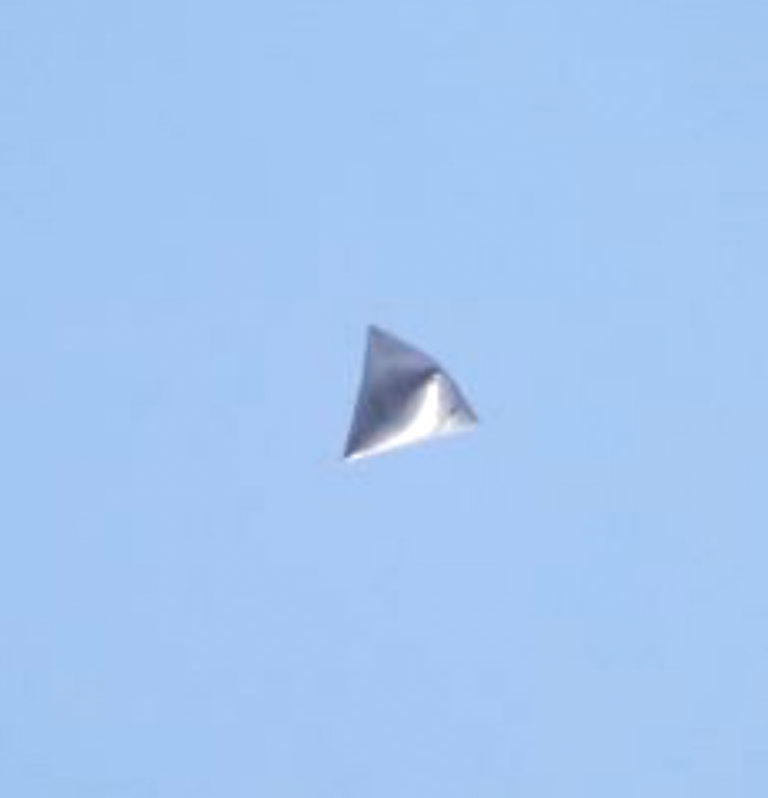
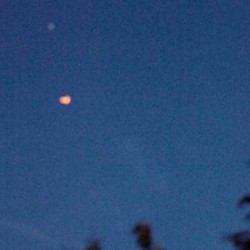
A UFO has been caught on camera in broad daylight flying over Edgware.
UFO over Edgware
Mark Lawes snapped the mysterious odject on Tuesday 23rd June 2009 just after 7pm, and has upload the pictures to his Flickr account: http://www.flickr.com/photos/marklawes
Mark writes: Time was 19:11 23/06/2009 Edgware London UK looking NNE. The Sun was 90 degrees west. No clouds clear sky. A glint in the sky caught my eye, this object was so far away I had trouble seeing it. I watched it for about 2 mins and it remained in the same place throughout. Decided to run for the camera, managed to locate it in the same place and focused camera best poss with 150mm digital lense on a Olympus E500 SLR. I took several continuous bursts and this is the result. It was not a plane I see plenty of them living near Heathrow Airport(15 miles). This was strange, didn’t move and the pictures now seem to mystify it more. I ran and got my binoculars and within 10 seconds of turning my back… it was gone.
New evidence suggest some, if not all European Cave Paintings were made by females, and not males as previously thought.
For about as long as humans have created works of art, they’ve also left behind handprints. People began stenciling, painting, or chipping imprints of their hands onto rock walls at least 30,000 years ago.
But until recently, most scientists assumed these prehistoric handprints were male. But “even a superficial examination of published photos suggested to me that there were lots of female hands there,” said Pennsylvania State University archaeologist Dean Snow.
By measuring and analyzing the Pech Merle hand stencils, Snow found that many were indeed female.
How did piranhas — the legendary freshwater fish with the razor bite — get their telltale teeth? Researchers from Argentina, the United States and Venezuela have uncovered the jawbone of a striking transitional fossil that sheds light on this question. Named Megapiranha paranensis, this previously unknown fossil fish bridges the evolutionary gap between flesh-eating piranhas and their plant-eating cousins.
Present-day piranhas have a single row of triangular teeth, like the blade on a saw, explained the researchers. But their closest relatives — a group of fishes commonly known as pacus — have two rows of square teeth, presumably for crushing fruits and seeds. “In modern piranhas the teeth are arranged in a single file,” said Wasila Dahdul, a visiting scientist at the National Evolutionary Synthesis Center in North Carolina. “But in the relatives of piranhas — which tend to be herbivorous fishes —the teeth are in two rows,” said Dahdul.
Megapiranha shows an intermediate pattern: it’s teeth are arranged in a zig-zag row. This suggests that the two rows in pacus were compressed to form a single row in piranhas. “It almost looks like the teeth are migrating from the second row into the first row,” said John Lundberg, curator at the Academy of Natural Sciences in Philadelphia and a co-author of the study.
Fossilised teeth and upper jaw of Megapiranha paranensis shows intermediate tooth arrangement between single-rowed piranhas and their double-rowed relatives. The fossil measures about 3 inches in length.
If this is so, Megapiranha may be an intermediate step in the long process that produced the piranha’s distinctive bite. To find out where Megapiranha falls in the evolutionary tree for these fishes, Dahdul examined hundreds of specimens of modern piranhas and their relatives. “What’s cool about this group of fish is their teeth have really distinctive features. A single tooth can tell you a lot about what species it is and what other fishes they’re related to,” said Dahdul. Her phylogenetic analysis confirms their hunch — Megapiranha seems to fit between piranhas and pacus in the fish family tree.
The Megapiranha fossil was originally collected in a riverside cliff in northeastern Argentina in the early 1900s, but remained unstudied until paleontologist Alberto Cione of Argentina’s La Plata Museum rediscovered the startling specimen —an upper jaw with three unusually large and pointed teeth — in the 1980s in a museum drawer.
Cione’s find suggests that Megapiranha lived between 8-10 million years ago in a South American river system known as the Paraná. But you wouldn’t want to meet one today. If the jawbone of this fossil is any indication, Megapiranha was a big fish. By comparing the teeth and jaw to the same bones in present-day species, the researchers estimate that Megapiranha was up to 1 meter (3 feet) in length. That’s at least four times as long as modern piranhas. Although no one is sure what Megapiranha ate, it probably had a diverse diet, said Cione.
Other riddles remain, however. “Piranhas have six teeth, but Megapiranha had seven,” said Dahdul. “So what happened to the seventh tooth?”
“One of the teeth may have been lost,” said Lundberg. “Or two of the original seven may have fused together over evolutionary time. It’s an unanswered question. Maybe someday we’ll find out.”
Scientists think they have resolved one of the most controversial environmental issues of the past decade: the curious case of the missing frogs’ legs.
Around the world, frogs are found with missing or misshaped limbs, a striking deformity that many researchers believe is caused by chemical pollution.
However, tests on frogs and toads have revealed a more natural, benign cause.
The deformed frogs are actually victims of the predatory habits of dragonfly nymphs, which eat the legs of tadpoles.