The transparent-headed Pacific Barreleye spends much of its time motionless, at more than 2,000 feet (600 meters) beneath the ocean’s surface.
The green lens atop each of the fish’s eyes filters out what little sunlight makes it down from the surface, allowing the fish to focus on the bioluminescence of small jellies or other prey passing overhead.
Then the eyes rotate forward to follow the prey, allowing the fish to home in on its meal.
The 6-inch (15-centimeter) Barreleye (Macropinna microstoma) had been known to science since 1939 – but only from mangled specimens found in fishing nets nets.
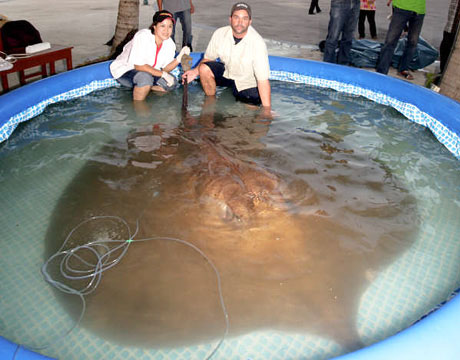
Fishers and scientists announced this week the catch, and release, of what is likely the world’s largest known freshwater giant stingray.
The giant stingray, weighing an estimated 550 to 990 pounds (250 to 450 kilograms) was reeled in on January 28, 2009, as part of a National Geographic expedition in Thailand.
The stingray’s body measured 6.6 feet (2 meters) wide by 6.9 feet (2.1) meters long. The tail was missing. If it had been there, the ray’s total length would have been between 14.8 and 16.4 feet (4.5 and 5 meters), estimated University of Nevada Biologist Zeb Hogan.
Hogan was in Thailand searching for giant fish as part of the Megafishes Project—an effort to document Earth’s 20 or so freshwater giants.
The new find gives Hogan hope that the giant stingray, once overfished, may be more abundant than previously thought. And it may confirm the giant stingray as the heavyweight champ of the Megafishes Project.
Ok, well to be honest the Guardian does have a point, the recent photo of an alleged 100 foot long snake cruising a river in Borneo has sparked huge debate and more importantly concern for locals living along the river – but it is “probably” just a fake, isn’t it?
Helen Pidd, author of Borneo’s 100ft snake stretches the truth, seems to think it’s definitely a fake and makes a point of saying, “The Guardian is not the first to point out a few problems with this photo. In fact, anyone with eyes, a vague ability to judge distances and an average talent for distinguishing truth from nonsense can see it is clearly made up. It is tempting to stick a “probably” in here in the style of those atheist bus adverts, just in case mutant fresh water serpents really do exist along with God and heaven and resurrection.”
A couple allegedly spotted the large animal cross the road while they were driving at the weekend (possibly Saturday afternoon). They stopped their car at the spot where the creature entered the hedge and looked in – too their surprise a large cats face was looking back at them!
I know the approximate location, but nothing else at the moment – but I am hoping to speak to the witnesses this afternoon and visit the area where the large cat was seen.
Update: After spending 2 hours walking around the alleged Big Cat sighting area, I must conclude I haven’t found any evidence… yet! I say yet, as I intend to re-visit the area again at the weekend, as there could conceivable be a chance that something is out there!
A massive rat weighting six ponds with a 12-inch tail has been caught in Fuzhou, a city on China’s south coast.
The rat was caught by a Mr Xian, who apparently saw a large crowd of people surrounding the monster in the street. He told local newspapers he thought it might be a valuable specimen, so mustered up the courage and grabbed it by the scruff of its neck.
Mr Xian then shouted “I did it, I caught a rat the size of a cat”. Mr Xian is believed to still be in possession of the animal, after stuffing into a bag and departing the scene.
Local forestry unit has identified the creature as a bamboo rat, but would like to examine the rat more closely before making a final identification.
The bamboo rats is (unsurprisingly) a species of rodent. There are four known varieties and the Chinese bamboo rat is found across China, Burma and Vietnam, with it’s larger cousin, the Sumatra bamboo rat found in Yunnan, Indochina, Malay Peninsula and Sumatra.
Bamboo rats vary in size, the smallest, the Lesser Bamboo Rat is typically 15 to 25 cm long (head and body: tail length is 6–8 cm), and weighs from 500 to 750 g, the largest, the Sumatra Bamboo Rat, can reach lengths of nearly 50 cm with a 20 cm tail, and weighs up to 4 kg.
However they are all bulky, slow-moving rodents that live and forage in extensive burrow systems where they feed on the underground parts of plants. They rarely spend much time above ground.
I am saddened and shocked to hear that an old friend of mine, David Kingston, died yesterday.
David has been a UFO researcher since 1976, and claims he first saw UFOs (Ords) while serving with the Royal Air Force in this country, America, the Pacific and the Far East.
In the late 80’s he began to investigate Crop Circles for a possible link after reports of spheres of light were seen hovering over fields prior to a crop circle appearing.
He later went on to run CPI (Crop Phenomena Investigations) and became the Dorset Convenor for the CCCS (Centre for Crop Circle Studies).
Then in the mid 90’s, having lectured on the subject of UFOs, Crop Circles and Conspiracies for many years, David started the very popular yearly conference in Dorchester, which has now run for over ten years.
This years conference had been put on hold following recent news that David was very ill with terminal cancer. I think this has come as a great shock to everybody who new him, and he will be sadly missed by all.
I’d like to pass on my condolences to his family and wife Mary.
An African serval wildcat similar to this was found in the backyard
A 58 year old man from New Orleans had a surprise when he checkout a noise in his mothers backyard – instead of finding a Raccoon going through the trash, Carl Henderson discovered a Serval Wildcat.
When Carl Henderson stepped into the backyard of his mother’s Uptown home Tuesday at mid morning, he was checking out a neighbor’s report of raccoon playing about.
He found something quite different.
Henderson encountered what looked like a small cheetah, 22 pounds and lean, two feet tall in the arch of its back, a long tail, with black and brown spots. An intimidating, lovely feline in an unlikely spot.
“The spots and design on it, the natural nature thing,” the 58-year-old New Orleanian said later in the day, still flabbergasted at the mysterious find. “An artist couldn’t do that. It was a sight for the eyes.”
What he found resting in the shade was a female serval, a small African wildcat, the possession of which is illegal for private citizens in Orleans Parish, Audubon Nature Institute officials said.
Henderson’s first instinct was to call the cops, nervous that the wildcat might harm children in the vicinity. But before the law arrived, he somewhat boldly tried to befriend the cat.
He took it water, then slices of American cheese, then pieces of turkey wing.
The cat lapped up the offerings, but bared her teeth and hissed when he drew near.
In my office I have a small mountain of boxes that contain all sorts of weird and wonderful material. Yesterday I sat down and went through one of them trying to catalogue the contents. I failed miserable because I ended up reading everything instead of just organising it in to categories.
What I did find though, was an interesting sighting of Caddy from a 1963 copy of Space Review. Cadborosaurus or ‘caddy’ as it is more commonly known, is a sea serpent that is reported to be living along the Pacific Coast of North America. Interesting, more than 300 sightings have been reported over the past 200 years.
Cryptoworld Archives: Taken from Space Review, August/September 1963.
“I saw strangest sight” Is Cadborosaurus, the often seen but never photographed sea serpent, back in Southern Vancouver Island water after a prolonged absence?
Alleged Cadborosaurus carcass, photographed in October, 1937
Mrs. R. A. Stewart believes so. She is sure she saw ‘Caddy’ or one of his cousins last Sunday afternoon (1st February 1963), near Gabriola Island. Mrs Stwart in entering the ‘I believe in Caddy’ contest organised by Times Columnist Monte Roberts, writes in part : “I have been reading a lot about Caddy and this i sthe first time I ever thought there could be any truth in such an animal.
“Sunday after my husband, children and I went up to Gabriola Island to explore the beach and do some fishing. We went out fishing in a small rowboat on the Gulf side, off my parents’ waterfront cottage.
We caught a good-sized codfish and as my husband was untangling the hooks, I looked out at the glass-like calm waters.
Mrs. Stewart who has boated in the area for 15 years is convinced that what she saw was not kelp, porpoise, blackfish, sea lion or any other ‘normal’ marine phenomena.
“I only wish some responsible persons would go over to Gabriola Island and row a few yards offshore on the Gulf side towards Loche Bay and see if they too, don’t see what we saw.”
Seems like a classic sighting, but I love the idea that responsible persons should row out and see if they can find it!
I’m going to try and sit down and organise the Archives a bit better – and I’ll definitely publish anything else of interest.
Talk about hype and conspiracy theory! At some point yesterday I received an email saying Atlantis had been found on Google Earth! Unbelievable I thought as I rushed to launch Google Earth and enter the coordinates 31 15′15.53N 24 15′30.53W – to my surprise it indeed did look like a road or street system on the sea bed. But, after zooming in and out a bit to get my bearings, I realised that if this really was evidence of an ancient road system or street plan, then the Atlantians must have be huge!
Atlantis? Probably not as the roads or streets would be huge! Note 30 mile long Madeira, top right.
If you look at the screen grab above, you will see the alleged Atlantis at the bottom left. It is worth noting similar lines near the middle and to the right, but more interestingly is the islands near the top right. That’s Madeira, the largest island of the Portuguese archipelago and approximately 30 miles (57 km) long by 13 miles (22 km) wide.
Putting that into perspective makes it hard to believe that this could be Atlantis, no matter how hard you try. Shame though, as it is near one of the most likely locations (see Location hypotheses of Atlantis).
What does Google say? Well to quote the last paragraph from CNET, and because I don’t really want to waist my time with this anymore:
When it comes to Atlantis, Google totally had to rain on everyone’s parade. “It’s true that many amazing discoveries have been made in Google Earth, including a pristine forest in Mozambique that is home to previously unknown species and the remains of an ancient Roman villa,” a statement from Google read. “In this case, however, what users are seeing is an artifact of the data collection process. Bathymetric (or sea floor terrain) data is often collected from boats using sonar to take measurements of the sea floor. The lines reflect the path of the boat as it gathers the data.”